Roman de Salvo: ELECTROSPECTRUM


Exhibition Reception: Friday, March 20, 2026, 6:00-8:00pm
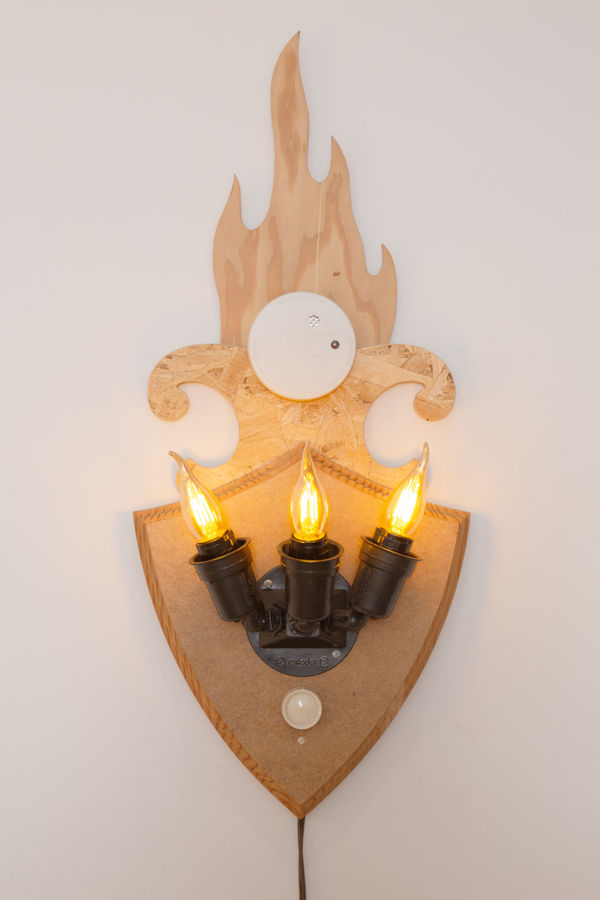
Quint Gallery is pleased to present ELECTROSPECTRUM, a survey of Roman de Salvo’s sculptures and early experiments united by the use of the lightbulb. Spanning works made between 1991 and 2026, the works in ELECTROSPECTRUM exemplify de Salvo’s longstanding engagement with material dualities: the ornate and the utilitarian, the handcrafted and the mechanical, and elements of nature which are both unruly and standardized. Across the past three decades, his sculptures transform everyday systems into sites of curiosity, play, and formal invention.
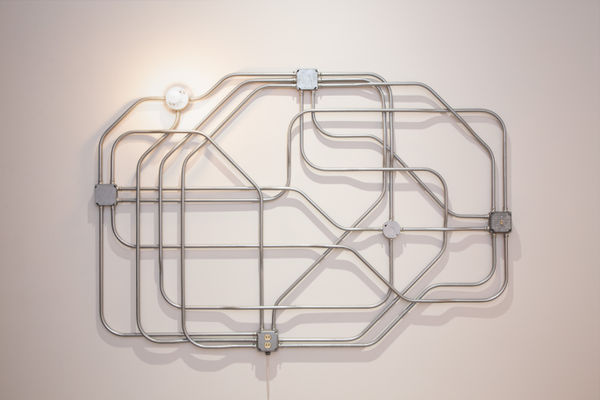
Using and manipulating manufactured, modular building materials like electrical conduits, light switches and bulbs, de Salvo is well known for his conduit works, which reinvent common hardware store materials into maze-like wall sculptures that hint at the complex interior systems powering the spaces in which they are shown.
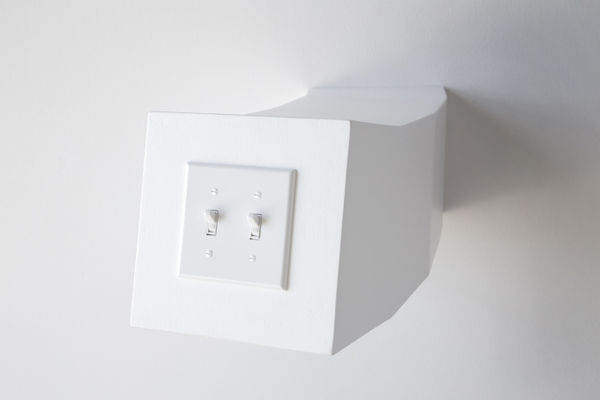
Early works in the exhibition reveal de Salvo as an inventor of novel but precarious approaches to producing light. In these foundational years, he sought to distill forms and concepts to their essentials, allowing form and function to go hand in hand until, at times, they no longer would. From creating analog lamps with oil- or wax-fueled flames housed within broken lightbulbs, to inserting a house key and copper wire into the sockets of a junction box to electrify a bulb, these idiosyncratic experiments give way to later objects that prioritize sculptural form while retaining an oblique relationship to utility. In works like Wall Prosthesis, a common light switch plate extends from the wall, to present the switches as an optimally angled control panel. Yet, the utilitarian gesture is cartoonishly stretched to absurdity, even as the switches operate the gallery lights.
In the following years, de Salvo developed beyond the impractical and embraced his skills as a meticulous craftsman, incorporating natural materials such as woods and stones selected for their distinctive grains, textures, and irregularities. In works such as Cave Light (2014), Farm to Table Lamp (2015), and Moonlight (2018), carved alabaster and hand-planed wood become highly articulated vessels for the common lightbulb, allowing light to assert itself as a sculptural medium.
The lightbulb, rife with associations to new ideas and knowledge, is also appreciated by de Salvo for its formal qualities, most recently echoed in his Lil Bulby series. The bases, derived from the shape of the bulb, are fired raku-style, an ancient Japanese ceramic technique that creates a unique finish to wares. While all ceramics are fired, the raku process tends to yield results that appear as though they’ve survived an actual fire. The ceramic object, removed from a hot kiln at such heat that its glazed surface is molten, is then abruptly dropped into a container of dry organic matter such as dead leaves. As the work undergoes thermal shock, cracks in the glaze spread across the surface and are infused with smoke from the smoldering leaves.
De Salvo often returns to past projects, sometimes remixing them from a new conceptual angle, such as his sculpture Electric Picnic Redux which appeared at ONE in 2022 after being developed at his 2019 residency at The Timken Museum of Art in San Diego’s Balboa Park. Responding to the museum’s collection of European Old Master paintings, de Salvo focused on Jean-Honoré Fragonard’s Blindman’s Bluff (1775), isolating the bifurcated tree beneath which a group of aristocrats gather and play. Reconstructed using slotted angle hardware and twin-socket lamp adapters, he transformed its rococo imagery into an illuminated sculpture surrounded by benches, inviting viewers to inhabit the work. For Quint ONE, de Salvo stripped back ornamentation and altered its base. At the center of ELECTROSPECTRUM is a third iteration of Electric Picnic, with yet another take on the erector set-like format.
Roman de Salvo was born in 1965 in San Francisco, California and grew up in Reno, Nevada. He received his BFA from California College of the Arts in Oakland, and his MFA from the University of California, San Diego in 1995. His work has been commissioned with notable institutions such as the Musee d’Art Americain, Giverny, France; the Whitney Biennial (2000), New York, NY; the Public Art Fund, New York, NY; the Museum of Contemporary Art San Diego; the Timken Museum of Art, San Diego; among others. He participated in the 1994 and 2000 editions of INSITE, with installations in San Diego and Tijuana, respectively. De Salvo currently lives and works in Reno, Nevada.